
Excellent LASIK Eye Surgery in New York, NY
LASIK Eye Surgery in New York City
Since its inception, LASIK has given tens of millions of people clearer vision and independence from visual aids. Many patients claim that having elective surgery is one of the best decisions they’ve ever made. By restoring clear vision, LASIK helps patients live fuller, more productive lives.
If you have a refractive error and can’t function without glasses or contact lenses, it’s worth considering your laser vision correction options with Dr. Sandra Belmont, a board-certified ophthalmologist LASIK Surgeon in New York City. She has played an instrumental role in the evolution of LASIK and is known around the world for producing truly remarkable outcomes.
Why Choose Dr. Belmont For LASIK Surgery?
Ask Dr. Belmont’s patients why they chose her to perform surgery and they will probably mention her experience first. A fellowship-trained corneal surgeon, Dr. Belmont played a key role in the development and advancement of laser refractive surgery. She served as one of New York City’s principal investigators in the FDA studies that led to the approval for LASIK and PRK.
Dr. Belmont has performed tens of thousands of procedures, and her patients include other doctors (her nickname is the “Doctors’ Doctor”), celebrities, heads of state and patients from all corners of the world that travel to her NYC practice in search of her expertise.
In addition to offering traditional LASIK, Dr. Belmont is especially known for her “No-Cut” approach to LASIK. No-Cut LASIK has a superior safety profile compared to conventional and bladeless LASIK because it eliminates the risk of flap-related complications. Yet it offers the same, and even better, visual outcomes versus LASIK and bladeless LASIK.
Traditional vs Advanced LASIK Surgery
Traditionally, the laser eye surgeon uses an individual’s lens prescription to calibrate the laser for the LASIK procedure. That means that if two patients have the same prescription, they will receive exactly the same treatment from the excimer laser.
At present, Dr. Belmont is able to employ advanced CustomVue wavefront-guided analysis to tailor and optimize the treatment or guide the laser. The distinct maps produced by the wavefront analysis quantify extremely subtle visual errors and details that the excimer laser will correct at the same time as it corrects for nearsightedness, farsightedness, astigmatism or presbyopia.
How Does LASIK Work?
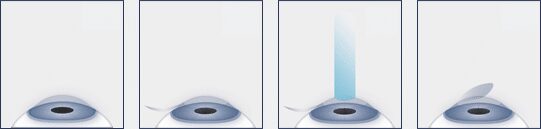
LASIK is a laser procedure that reshapes the cornea so it can correctly refract light onto the retina. During a traditional LASIK procedure, a thin flap is created in the surface of the cornea with a microkeratome (or in bladeless LASIK, a femtosecond laser). Then, an excimer laser is used to reshape the corneal tissue. Afterward, the flap is restored over the eye, where it heals itself.
LASIK Before & After Surgery
Are You A LASIK Candidate?
In general, suitable LASIK candidates include individuals who:
- Have healthy eyes
- Have stable vision with a prescription that has not changed for at least one year prior to the vision correction procedure
- Are at least 18 years old if treating nearsightedness or at least 21 years old if treating astigmatism
- Do not have a degenerative or autoimmune disease
- Do not have any health conditions that impede the body’s healing processes
- Are not pregnant or nursing
What Happens If You Are Not Eligible?
If, for some reason, you are not medically eligible to undergo LASIK in Manhattan with Dr. Belmont, do not fret! You may be an appropriate candidate for another vision correction procedure such as PRK. Although PRK laser eye surgery is actually the precursor to LASIK, it offers visual results that are very similar to LASIK results and has certain advantages over LASIK.
For instance, LASIK surgery involves creating a flap in the cornea. In contrast, with PRK, Dr. Belmont does not have to make an incision in the eye. Instead, she uses a laser to ablate the surface of the cornea. Although it may take a few more days to notice an improvement in vision with PRK, there are none of the side effects associated with creating a corneal flap during LASIK surgery.
In the past, when the FDA had only just approved PRK for vision correction, only individuals with mild to moderate nearsightedness were considered appropriate candidates for PRK. But thanks to advancements in PRK and other advanced surface ablation (ASA) techniques, most patients are now eligible for PRK, and it is considered an outstanding alternative to LASIK.
During your initial visit to Belmont Eye Center in New York, Dr. Belmont will review your eye health and medical history as well as listen to your vision-correction objectives. Based on your unique eye anatomy and surgical goals, she will recommend a treatment protocol that is tailored to satisfy your needs.
To schedule an appointment with Dr. Belmont and determine your LASIK eligibility, please contact Belmont Eye Center by calling (212) 486-2020.

What is Recovery from LASIK Like?
It is extremely important that all post-operative instructions be followed to the letter after your treatment. An instruction sheet will explain the use of medicated and lubricating eye drops to be used post-operatively. These instructions for these drops and all other instructions will apply until the doctor modifies the regimen in the course of your post-operative visits. Typically, patients will be seen one week, two weeks, one month, two months and three months after their procedure. After that, six, 12 and 24 month visits will be suggested.
You will be advised to:
- Wear the plastic shield / goggles provided at bedtime, or whenever you lie down, for five days after the procedure
- Wear protective sunglasses when outdoors for one week after surgery
- Refrain from extended work on a computer on the day of your procedure
- Try not to rub your eyes at all
- Avoid perspiration in the eyes for one week
- Abstain from sexual activity for 24 hours
- Restrict exposure to pet hair for one week
- Avoid wearing eye make-up, especially mascara, for 10 days
- Avoid using a hot tub, steam room, sauna or pool for two weeks
- Avoid lake or ocean swimming without goggles for one month
How Much Does LASIK Cost?
LASIK depends on the particular procedure and technology used. Cost and financing options are discussed during the consultation phase.
State-of-the-Art Precision at Belmont Eye Center
Your journey to visual freedom begins with the most sophisticated diagnostic suite in Manhattan. At Belmont Eye Center, we utilize advanced corneal mapping and state-of-the-art wavefront technology to create a highly detailed, 3D fingerprint of your eye.
This level of precise measurement allows us to customize every single treatment, ensuring that your LASIK eye surgery addresses even the most microscopic imperfections in your cornea. By combining clinical excellence with custom laser calibration, we consistently deliver the sharpest, clearest vision possible for our patients.
What to Expect After LASIK Surgery New York, NY
The transformation after laser vision correction is often described by patients as life-changing. Immediately following your procedure, you will begin to notice a dramatic reduction in your dependence on glasses and contact lenses. Most patients return to their normal daily routines, like driving and working on a computer, within just 24 to 48 hours. Over the following weeks, your eyes will continue to stabilize, leaving you with crisp, clear, and effortless vision.
To learn more about the pioneer leading these transformative procedures, explore the background of our world-renowned LASIK eye surgery specialist.
Preparing for Your Personal Consultation
Before undergoing any laser vision correction procedure, a comprehensive evaluation is essential. During your initial visit, we will thoroughly assess your corneal thickness, eye shape, and overall ocular health to confirm your eligibility. If you wear contact lenses, you will be asked to switch to glasses for at least two days before your exam, as contacts can temporarily alter the natural shape of your cornea.
Ready to take the first step toward clear vision? Schedule your consultation with us today to find out if you are a candidate for LASIK surgery in New York, NY.
LASIK Eye Surgery FAQ’s
Schedule A Consultation With Dr. Belmont
Find out if you are a candidate by calling or emailing today.
More than 100 eye doctors or their family members from around the world have chosen Dr. Belmont to perform their surgery. Shouldn’t you? Want to see it all, without your glasses? To schedule your Complimentary Consultation, call us or click here to schedule an appointment online.


